
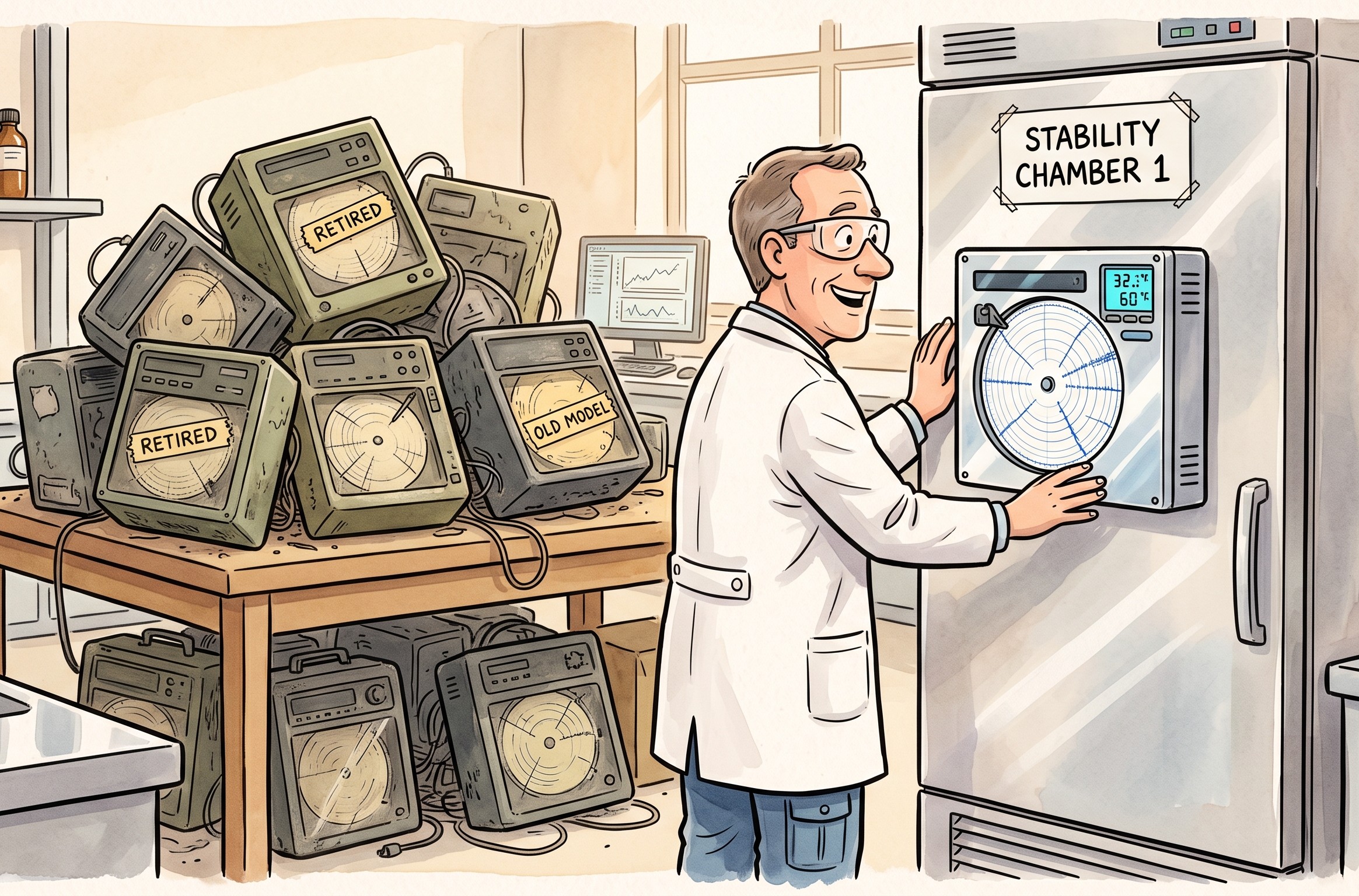
Let’s take a look at the evolution of environmental chamber monitoring systems. Are you fully evolved and up to date with the latest technology, or are you getting by with an adequate electronic system that is working just fine for you? There are still companies that print replacement chart paper and manufacture the pens and ink for those skinny writing arms, so it’s very likely that some of you reading this still enjoy changing the paper each week and manually checking for excursions that might have occurred without your knowledge. Others of you may have taken the risk to try newer technologies and might still be in limbo as to their advantages. Either way, no judgement here, just information.
The purpose of this article is to increase awareness of the latest technology that people are using for monitoring stability chambers, while at the same time, help some of you feel OK about the technology that you’re still using. The fact is, if it’s still working and is compliant and not costing you too much in resources then you might be just fine where you’re at since the expectation of industry isn’t that you’re at the top of the technological food chain, just compliant, and the only compliance expectation is that you’re collecting temperature and humidity (and maybe light) data in an ALCOA manner, and that you’re routinely reviewing the data and documenting that review.
So, let’s jump right into the latest technology and devolve to the primordial soup.
Predictive Analytics
Air handlers have a lot going on; adjusting baffles for proper air mixture, sending current to heating elements, opening or closing chilled water, varying fan motor speeds and much more. All of the data points directing these actions are being gathered by the air handler and passing through its controller to help make the right “decision” to keep your chamber in the middle of its setpoints. This information can also be collected for more than just an instantaneous reaction from the controller—they can be fed through artificially intelligent software systems to help forecast mechanical failures.
All you might really be interested in monitoring is the temperature and humidity, but the latest available technology can give you a complete bill of health of the system at any given time by collecting key control parameter data, uploading to a secure cloud data service and continuously running the data through algorithms to detect for any aberrant shift in data trends that might signal a problem. Lower air speed might indicate a fan motor is weakening, or higher condenser temperatures might indicate an unexpected humidity source, like maybe a ceiling leak. Imagine a world where PMs are more than just a list of mandatory replacement parts and cleaning protocols, but where they include specific targeted repairs of parts before they fail enough to cause an excursion.
And, what about data reviews? With the latest software you can eliminate the bothersome weekly or monthly task of pulling up data and pouring over charts to check for unexpected spikes or shifts in the baselines—just have the AI system do it. It can summarize your system’s health, highlight key shifts or spikes, and provide key information about your chamber’s environment over the past week or month and then just e-mail it to you. You then document your review of those reports and voila, done for this month. Then you can go home on the Friday before Labor Day weekend and plan on sleeping well.
OK, more costly to acquire, to validate and implement, but oh, so worth it and so impressive to show in an inspection tour (if asked, of course). A stabilitarian could easily show that the capital expense would be covered by reduced excursion investigations and CAPA, lowers review time and eliminated emergency repair costs. Sure, it’s not fool proof, but let’s say this new system catches just 50% of your future unplanned outages before they happen so you can make a scheduled repair or move product. Even that low-end estimate would be an impressive improvement.
Wireless Cloud Monitoring
It might not be time to make the AI jump, but if you trust modern data acquisition and storage technologies you might be ready for a system set up to wirelessly collect and transmit the required environmental data while not delving deeper into the system health tracking and AI analyses. You’re still right up there next to the fully evolved monitors. By collecting temperature, humidity and maybe even light intensity and exposure times for photostability and uploading this data continuously to a cloud server it can be called upon in real time at any time and anywhere and can be set up to run reports and charts for review. The reports might not be as predictive in nature but they will still greatly reduce the time spent reviewing chamber performance. I would venture to guess that a set of AI “eyes” could still run through the data for a quick evaluation of undetected shifts in these few parameters that might hint at a system performance issue.
Just as with predictive analytics systems, you will have to commit significant resources to acquire and validate the application, but these wireless (WIFI or Bluetooth) monitors will be much easier to set up without physically pulling wires. The cost, arguably, would not be much more than the next lower-technology option, so why not just go this route? If your program is already at this stage in the monitoring evolution you’re doing very well and probably have a very reliable system providing everything that any stabilitarian had ever dreamed of in the last 70 years for their monitoring system.
Centralized Wired Local System
Although we’re three steps down in this evolutionary chain, we’re still talking cutting edge technology compared to historical monitoring systems. At this stage you’re continuously collecting data possibly from multiple points within the chambers from hardwired monitors that don’t need to be recharged. The data is feeding to a local server and probably buffering there while being forwarded on to a central server on site somewhere. The local server serves as the backup in case the connection to the central server is temporarily lost, whereas in the previous two higher levels of evolution the monitors themselves stored their own data for future uploading in the case of a network connection failure.
Since this technology has been around for a few decades now, there are numerous options for setting up one of these systems—Vaisala, Rotronic and Dickson to name a few well-known probe manufacturers. There are also a number software interface options to go with the probes, most are quite customizable. At issue is how pretty you want things to look on the front end. For 10 years I worked with a Honeywell system that was essentially built inhouse just for our chambers. It worked, it was pretty flexible, we could access the data anytime and anywhere and it printed nice charts. The system was derived from our company’s existing manufacturing controls, so we had the inhouse know-how and frameworks to build it and saved a ton of money. I had seen prettier systems that looked really nice and did feel a bit let down when we went live, though. It always felt to me like we were one hiring freeze away from losing vital support to keep it running or to make any updates. One of the biggest hurdles I experienced with hardwired monitors was having to move them when requalification mapping indicated new high/low monitoring points and the wires weren’t long enough to reach the new primary monitor locations. Oops.
If you have one of these systems, I dare say you’re probably quite content with what you have but are salivating a little for something even nicer. I’d also dare say that you are still in the majority, as these types of monitoring systems have proven reliable, easily validated, calibrated and interfaced. The prospect of jumping from this technology into wireless probes and data collection can be daunting and quite costly compared to the continued adequacy of what you already have, which I understand and actually agree with. The key driver to move on to something better would be the aging interface software, server and database systems supporting your end user experience and whether or not it’s up to current data integrity standards. If your system is more than 10 years old, it’s probably time to start making the financial arguments to management to support an upgrade. Imagine no longer feeling a little scared and worried every time you pull up the main monitoring screen on your computer. Imagine not having to worry if it will keep doing what it was designed to do.
Digital Dataloggers
I’m going to go out on a limb and say that I’m pretty sure this solution has rarely, if ever, been used as a primary monitoring option. This evolutionary phase in monitoring technology came about as people needed a backup option to make up for their paper chart recorders jamming, pens running out of ink, or heaven forbid someone loading a chart paper incorrectly—did you remember to get the little knobby securely into the little hole in the paper? But companies were basically still stuck with paper charts since at that time technology wasn’t offering a sufficiently reliable replacement. So, their next best option was remote data loggers (usually battery powered in some way) as a redundant data collector that required data to be uploaded when needed or possibly even erased to free up memory space.
Digital dataloggers were coming onto the scene before the industry-wide data integrity revolution, so at the time they were a welcome solution to the age-old gaps faced with chart recorders. The cavalier handling of the data from these redundant systems seems a bit shocking today, but even these dataloggers have evolved so that there are a number of companies using some form of them as redundant backup systems. Since it’s so well known, I’ll mention TempTales. I doubt anyone is using them as a primary monitoring option—though it’s not totally out of the question—but as a redundant backup monitoring option, they continue to be a viable option paired with strong procedural requirements for data retention and review. As such, they might cause more of a resource drain than they’re worth, but then again, they’re quite cheap.
Analog or Digital Chart Recorders
I’m going to lump both analog and digital into this evolutionary phase, since the rise of digital chart recorders completely replaced analog ones, so I’m doubtful anyone out there has one in use. If you do, please let me know, I’d love to see it! But either way, the manual changing of charts each week, physically signing and verifying and storing them and all of the potential errors that could come up within the week really didn’t disappear during the long transition from analog to digital. What really shifted over the years has been the increase in resources to make sure the charts don’t fail unknowingly, i.e., the very common daily or even twice-daily walkthroughs.
Kudos to you and your company if you still rely on paper charts. You’re sticking with what is tried and true and with what you know an inspector won’t question. They might ask your process for handling them and they might want to see a few archived examples to prove you’ve stuck to your procedure, but they’ll never question the validation of their use or the accuracy of their output.
So, by keeping these on hand you’re making some resource sacrifices in exchange for a cost effective, reliable and compliant system—a reasonable sacrifice as long as you’re a relatively small program (let me say fewer than 10 chambers to monitor). With the rise in the expectation to monitor at both the high and low points from your last thermal mapping exercise, the number of monitors has doubled in recent years, and with that, the many charts to replace each week and the number of technical failures that are inevitable has to be daunting. After adding in the redundant dataloggers or backup chart recorders you could be expending nearly a half headcount just keeping the monitoring system afloat each week. It’s working, but there’s a limit to how value-added it really is when the cost benefit and resource freeing value of going with a top-tier option could cause an audible technological shock.
Summary
Bottom line, everyone in stability hates change. We are set up to force change and expect it and to collect data to detect it all day every day but we hate change. “Change is bad.” That is why I would guess that every stability program in place for more than 20 years probably is or at least was 5-10 years behind the technology of monitoring systems. For small programs, even chart recorders will work perfectly well, though they are probably causing more of a headache than you know and you’d be shocked at the freedom offered by top tier technology options. For programs with ten, fifteen or more chambers, it’s really time to do the math and make the financial and compliance argument for bringing on the latest technology. I’m certain you will be happy with the decision.
Share This Article with the Stability Community!
September 6, 2026

Quality Management is appropriate at all times in all settings, but Stability Operations is fraught with quality events at multiple levels, leaving the Stabilitarian [...]
June 28, 2026

Foreword by John O’Neill: An accelerated stability failure is not always the end of a product's story but how a failure episode concludes can [...]
June 6, 2026

Covid-19, Trump-tariffs and the Iran war have brought changes to the pharmaceutical supply chain guide in unanticipated ways. Japan’s MHLW has released a notification [...]
Share your questions and experiences
A stabilitarian encounters new situations every day. StabilityHub’s discussion forums give Stabilitarians an opportunity to ask questions and offer solutions to specific scenarios. Join in the conversations with other Stabilitiarians and share your knowledge!
A stabilitarian encounters new situations every day. StabilityHub’s discussion forums give Stabilitarians an opportunity to ask questions and offer solutions to specific scenarios. Join in the conversations with other Stabilitiarians and share your knowledge!
