
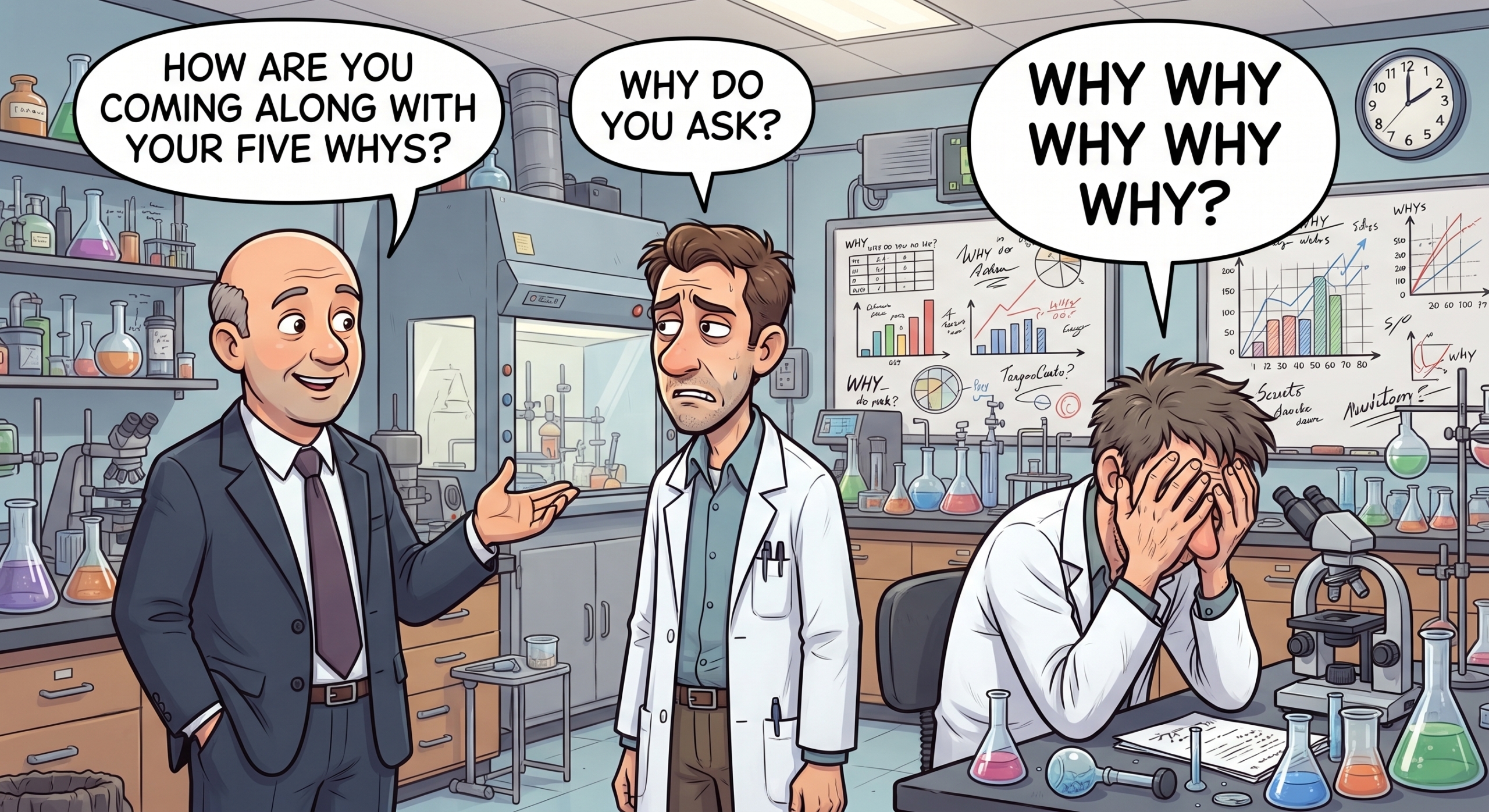
Quality Management is appropriate at all times in all settings, but Stability Operations is fraught with quality events at multiple levels, leaving the Stabilitarian to decide on an appropriate quality response that adequately addresses the problem without wasting resources and time. This article seeks to explore what criteria we might use in making decisions that satisfy the needs of our quality system as well as the expectations of regulatory inspectors. It’s fashionable in these risk-averse times to universally take the CAPA (Corrective and Preventive Action) approach, but this can be problematic without the right process. As in all cases, there can be many opinions and many solutions to a Quality issue. The opinions expressed here may not match those of your Quality organization or the next regulatory inspector to cross your threshold. Be sure you have sound justification as well as Quality management approval for whatever approach you select to address a Quality issue.
In The Beginning
Near the dawn of time, when the Stability Group was a new concept, a mishap may or may not have been a deviation. If an SOP was not followed and something went amiss, a Deviation Report was filed, something akin to a written confession that was more about assigning blame than it was about fixing a problem.
Eventually, Quality Management evolution brought root cause analysis and the requirement for Corrective and Preventive Actions. The extra work required for this new CAPA policy often tended to bring out check-box behavior from the uninitiated and without proper application, CAPAs could take on runaway proportions but over time and with increasing regulatory oversight, CAPAs were more widely pursued.
An Industry Problem
Insufficient CAPA procedures have been near the top of the FDA’s most-cited observations in medical product inspections for years. The distinguished folks at NSF have observed in their white paper Why CAPA Keeps Failing and What Strong Organizations Do Differently, that in many cases, “CAPA is consuming effort without reducing risk. Across global medical product organizations, CAPA systems consume a significant amount of time and resources. Investigations are opened, actions are assigned, and records are closed on schedule. Despite this activity, the same failures often reappear across sites, audits, and product families. This pattern creates three problems.
- Inspection risk increases because repeated issues signal ineffective corrective action.
- Quality teams become overloaded with documentation work that does not improve outcomes.
- Leadership confidence erodes because CAPA appears compliant on paper but unreliable and ineffective in practice, consuming time without delivering improvement.
The issue is not a lack of CAPA activity. It is a lack of CAPA effectiveness.”*
*Why CAPA Keeps Failing and What Strong Organizations Do Differently NSF, February 25, 2026 White Paper
Is Your CAPA in the Guinness Book of World Records?
On the occasion of my promotion to a Medical Device Quality Steward, I inherited the corporation’s largest and longest standing CAPA. Its previous owner was overjoyed to pass it on, as it had continuous corporate and regulatory scrutiny. Resolution would require completion of new global systems and coordinated SOPs, a long international process at best, and not a great undertaking for a mid-level underpowered manager at a local site. Predictably, this CAPA was later inherited by my successor.
Thankfully, there’s been much work done with quality experts to triage quality events, right-size CAPA’ s, manage their resolution and accomplish their intended purpose within realistic and achievable timelines. Within these efforts, there’s plenty of room for lower level actions before the Big C is unleashed.
Here are some practical definitions that might be helpful (Consult official sources on your own for academic and regulatory versions)
How to Start
It begins with an “Aught-Oh”, or maybe “Oh, xxxx”, something that you didn’t want to happen has occurred. Something must be done and determining the appropriate level of response can make or break your career, if not your entire organization.
Begin with a list of escalating questions.
Evaluation of Severity
Determine a Response Appropriate to the Scale of the Problem
Be Proactive.
Metrics like those below can be great diagnostics for quality problems.
Some Experts Say
Use immediate correction or log-based tracking for minor issues to save time and protect quality team resources.
Why Skip Full CAPA for Minor Issues?
Better Ways to Handle Minor Issues
Some Scenarios for a Range of Observation Responses
Note: The solutions listed are my own as practical guidance to the Stabilitarian. Always check with your Quality System Management before implementing your own responses.
Scenario 1
A screw holding a chamber door handle in place falls out. No procedure or program impacted
Solution: A simple fix. The problem is low risk, not a deviation and not yet part of a trend.. Each Aught-Oh, no matter how small, should be documented in an appropriate record that could capture the start or continuation of trends
Scenario 2
A technician forgets to turn off a chamber light. Internal temperature rises, but not enough to go out of spec. or trigger an alarm.
Solution: This is only a deviation if a procedure requires turning the light off. A Simple Correction/Continuous Improvement may be appropriate. Turn the light off. As a preventive action, put procedures in place to ensure a Technician checks for lights left on, in every room pass and at the end of every shift.Record the incident as a means to detect trends.
Scenario 3
A Laboratory system failure causes stability testing to miss its start window.
Solution: Deviation Report, CAPA is indicated since this is a system failure.
Scenario 4
A Stability Staff member misses a training deadline by a day.
Solution: Deviation Report. If staff performs duties without the training update, CAPA is in order. If the organization spots this potential problem before it occurs, a Preventive action is in order.
Scenario 5
Several Stability Staff members miss training deadlines.
Solution: Systemic problem. Deviation and CAPA required.
Scenario 6
A stability chamber goes out of specs triggering a response and subsequent report.
Solution: Deviation Report. Corrective action/Simple fix if isolated event. Evaluate for Preventive Action (improved preventive maintenance) and/or Continuous Improvement involving maintenance and monitoring such as with Predictive Monitor equipment.
Scenario 7
The same chamber goes out of specs on 3 different occasions.
Solution: Deviation and CAPA to address the recurring problem.
Scenario 8
It’s discovered that the chamber brand and model contains a compressor that is known for failure between 12 and 18 months.
Solution: Preventive Action.
Scenario 9
Chamber inventories have been shown to be consistently inaccurate and other sample-based systems are exhibiting similar issues.
Solution: Sitewide/ Corporate CAPA
A Personal Caution
The references cited in this article contain a wealth of CAPA wisdom. Here’s a nugget from personal experience; Multiple inventory discrepancies were discovered in our Stability Area and a CAPA was launched in accordance with our SOPs. A regular aspect of CAPA procedure is to determine if the problem also occurs in other departments or sites. This is a prudent step, but needs to have some practical considerations regarding scope, deadlines and responsibilities. In our case, a junior staff member launched the initial CAPA for which she was well-qualified, but as other departments and sites were found to have inventory problems, oversight for the now widely expanded multi-site CAPA remained with the original junior staff member who had neither the time nor the managerial clout to deal with the other areas.
Summary
Build your quality systems carefully. Don’t put unrealistic requirements into effect that will cause Deviations to fall like rain. Don’t launch CAPAs if simple fixes, corrections, prevention or continuous improvement initiatives are appropriate, and finally, design right-sized CAPAs that have a prayer of completion in a reasonable amount of time. If necessary, have your CAPA target a workable near-term correction and assign a multi-national, multi-year, multi-million Preventive Action to a Continuous Improvement project that won’t condemn a CAPA to near-term deadline failure. Stay in touch with your fellow Stabilitarians and organizations to monitor best practices and the regulatory environment others encounter.
References
- 21 CFR § 820.100 – Corrective and Preventive Actions (CAPAs)
https://www.ecfr.gov/on/2026-02-03/title-21/chapter-I/subchapter-H/part-820/subpart-J/section-820.100 - ICH Harmonised Tripartite Guideline: Pharmaceutical Quality System Q10
https://database.ich.org/sites/default/files/Q10%20Guideline.pdf - ICH Q8, Q9, Q10 Implementation
https://database.ich.org/sites/default/files/ICH_Q9%28R1%29_Annex_1_Q8Q9Q10_QAs%28R5%29_1030.pdf - Corrective and Preventive Action (CAPA), Assyro
https://www.assyro.com/blog/corrective-preventive-action-capa-guide - Corrective and Preventive Action (CAPA): The Definitive Guide, The FDA Group, Updated for 2026
https://www.thefdagroup.com/blog/definitive-guide-to-capa - 5 Most Common Problems with Your CAPA Process, Jon Speer, Greenlight Guru, September 30, 2025
https://www.greenlight.guru/blog/5-most-common-problems-capa-process - What Is CAPA in Quality Management? (With Real-World Examples), Dot Compliance, April 10, 2026
https://www.dotcompliance.com/blog/capa/what-is-capa-in-quality-management-with-real-world-examples/ - CAPA in the Age of Generative AI, Dot Compliance, May 11, 2023
https://www.dotcompliance.com/blog/artificial-intelligence/generative-ai/ - Why Do Most CAPAs Fail? And How to Make Them Work, Kiran Myalur Dharmaputhra (Boston Scientific), Quality Digest, May 19, 2026
https://www.qualitydigest.com/inside/qms-and-standards-article/why-do-most-capas-fail-051926.html - 5 Key Elements of an Effective CAPA System: Common challenges medtech companies face, and how to overcome them, Etienne Nichols, Greenlight Guru / Quality Digest, July 15, 2025
https://www.greenlight.guru/blog/the-5-key-elements-of-an-effective-capa-system - Why CAPA Keeps Failing and What Strong Organizations Do Differently, NSF Whitepaper, February 25, 2026
https://www.nsf.org/knowledge-library/why-capa-keeps-failing-what-strong-organizations-differently - Evaluating Effectiveness of a CAPA (or Any Other Fix), FDA
https://www.fda.gov/media/142009/download
Share This Article with the Stability Community!
October 9, 2026
Let’s take a look at the evolution of environmental chamber monitoring systems. Are you fully evolved and up to date with the latest technology, [...]
June 6, 2026

Covid-19, Trump-tariffs and the Iran war have brought changes to the pharmaceutical supply chain guide in unanticipated ways. Japan’s MHLW has released a notification [...]
June 6, 2026

We stabilitarians share and discuss our knowledge and experience because we care about the industry and have a special bond with our peers at [...]
Share your questions and experiences
A stabilitarian encounters new situations every day. StabilityHub’s discussion forums give Stabilitarians an opportunity to ask questions and offer solutions to specific scenarios. Join in the conversations with other Stabilitiarians and share your knowledge!
A stabilitarian encounters new situations every day. StabilityHub’s discussion forums give Stabilitarians an opportunity to ask questions and offer solutions to specific scenarios. Join in the conversations with other Stabilitiarians and share your knowledge!
