

Stability programmes are built on control. Chambers are qualified, environmental conditions are monitored, and protocols define how samples should be stored throughout a study. Yet one part of the stability process often receives less attention: the movement of samples between controlled environments.
That movement matters because stability data is frequently used to support labelled storage conditions, justify transport and distribution strategies, and assess temperature excursions that occur once products enter the supply chain. Confidence in those decisions depends on confidence in the samples used to generate the data. If a stability sample’s transport history is unclear, poorly controlled or poorly documented, it can become more difficult to defend the conclusions drawn from the study.
This is not because regulators routinely inspect stability sample transportation in the same way they inspect commercial GDP distribution. Stability sample transport is rarely scrutinized as a standalone activity. However, transport history forms part of the evidence supporting confidence in the resulting stability data. For that reason, organizations should understand and appropriately manage transport-related risks where they could affect sample suitability, data integrity or the defensibility of study conclusions.
In this article, we explore how GDP-informed control principles can help organizations apply proportionate, risk-based controls to the movement of stability samples. The goal is not to treat stability sample transportation as commercial distribution, but to strengthen confidence in the data that stability programmes are designed to generate.
Why protecting stability samples during transport deserves attention
Stability studies are not carried out in isolation from the wider product lifecycle. The data they generate helps organizations understand how a product behaves over time and in storage, but it can also support wider quality decisions, including labelled storage conditions, commercial distribution strategies and the assessment of short-term temperature excursions during transport. For that reason, the integrity of stability samples used to generate that data matters beyond the study report. If those samples have an unclear or poorly documented transport history, it may weaken confidence in product quality decisions that depend on the data.
Protecting stability samples during transport is therefore more than just a logistics issue. Whether samples move from manufacturing to storage, from storage to a testing laboratory, or between study locations, organizations should be able to demonstrate that the transport conditions did not compromise the sample’s suitability for continued use in the stability programme.
What do the ICH guidelines say?
ICH Q1 provides the framework for evaluating product stability, but it does not prescribe how stability samples should be transported. Instead, organizations must translate its principles into risk-based local controls that keep samples suitable for their intended use and ensure any conditions that could affect stability are justified and documented.
The current draft ICH Q1: Stability Testing of Drug Substances and Drug Products (2025 revision) recognizes that stability can be affected by environmental and physical factors including:
The new draft guideline also introduces specific references to:
However, it does not prescribe:
Although the new guideline does not prescribe transport controls, its direction makes them increasingly relevant to defending stability data. In practice, stability samples may spend time outside direct site control during courier hand-offs, weekend delays, customs checks, airport layovers, warehouse holds or delayed transfer into controlled storage on receipt. These are the points where the assumptions in the stability protocol can become harder to defend unless the risks have been considered in advance.
Key principles that can be inferred from ICH requirements
Although ICH does not contain a dedicated section entitled “Transportation of Stability Samples,” the following expectations are consistent with ICH stability sample transport:
- 1Samples should remain suitable for continued use within the stability programme
- 2Transportation arrangements should be scientifically justified and documented
- 3Risk-based approaches should be applied where transport could affect stability outcomes
Why GDP principles are still useful
Stability sample transportation is not generally subject to the same regulatory expectations as commercial GDP distribution. However, GDP inspections can provide useful insights into the types of transport-related control gaps that may make it more difficult to demonstrate what conditions a sample experienced during transit.
GDP principles emphasize documented evidence, defined responsibilities, effective monitoring and the investigation of unexpected events. Applied proportionately, these principles can help organizations understand and manage transport-related risks where they could affect confidence in stability samples or the resulting stability data.
At a 2025 PDA event on GDP, Ireland’s Health Products Regulatory Authority (HPRA) identified transportation as a frequent source of major deficiencies observed during GDP inspections. Examples included inadequate transport validation, insufficient route justification, gaps in calibration evidence, limited seasonal challenge data and weaknesses in excursion investigation.
While these findings relate to commercial distribution rather than stability programmes, they highlight recurring themes that are equally relevant whenever organizations need to demonstrate what conditions a stability sample experienced during transport.
GDP Transport FindingsLessons for Stability Programmes |
|
|
Most regulatory observations relate to commercial distribution, but the underlying themes may also be relevant where stability samples pass through shared, uncontrolled or partially controlled transport environments |
|
| Validation & qualification gaps | Evidence & ownership gaps |
|---|---|
|
|
For stability teams, the practical takeaway is that transport-related risks should be managed using a proportionate, evidence-led approach. The level of control will depend on factors such as product sensitivity, route complexity, shipment duration and the potential impact on the interpretation of stability data. Where transport conditions could influence study conclusions, risk assessments, monitoring data and clearly defined responsibilities provide evidence, support confidence in the resulting stability data and help underpin defensible conclusions.
Qualification, validation, and control
Qualification, validation and control are closely related concepts, but they serve different purposes. Together, they provide the evidence needed to demonstrate that transport conditions have been understood, assessed and appropriately managed. This is important not only for the movement of stability samples themselves, but because stability studies often generate data that is later used to support commercial distribution strategies, labelled storage conditions and assessment of transport excursions.
| Term | What It Means | Questions It Answers |
|---|---|---|
| Transport qualification | Evidence that a defined shipping system, packaging configuration or route is capable of maintaining the required conditions. | Can this route, packaging or shipping set-up maintain the required conditions under expected and challenged conditions? |
| Transport validation | The documented process of demonstrating that the overall transport approach performs as intended for its defined use. | Can this transport process consistently perform as intended for the stability sample movement it is being used for? |
| Transport control | The ongoing procedures, responsibilities, monitoring, acceptance criteria, escalation steps and deviation processes that keep shipments managed consistently. | How do we manage each shipment so transport risks are prevented, detected, assessed and documented? |
For stability study conclusions to be scientifically defensible, organizations need confidence that the stability samples used to generate data have themselves been managed appropriately throughout the study lifecycle, including during transport.
Risk points for stability sample transport
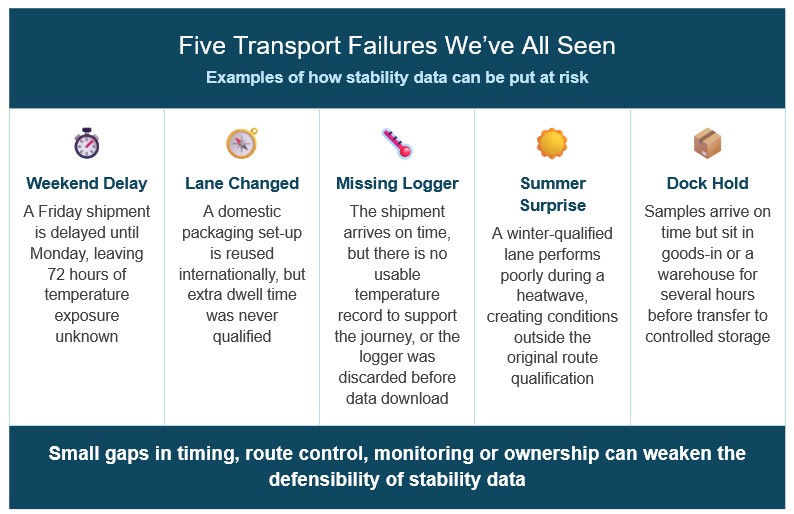
Stability sample shipping often sits between multiple functions: manufacturing prepares the samples, logistics arranges the shipment, the courier moves the material, the stability team owns the study and quality defends the resulting data.
This can create an operational grey area unless ownership of transport-related risks are clear before the shipment begins.
Monitoring does not equal control
Monitoring alone cannot compensate for poor planning. A calibrated logger can show what happened, but transport control comes from:
Stability shipping should therefore begin with the transport strategy, not simply the activation of a logger. Monitoring tells you what happened; control is what prevents problems from occurring in the first place.
Different monitoring technologies provide different levels of visibility, responsiveness and environmental insight. The most appropriate choice will depend on factors such as route complexity, shipment duration, product sensitivity and the level of evidence required to support the study.
Single-use temperature data loggers
| Advantages | Limitations |
|---|---|
|
|
| Best use: Routine shipments where a validated packaging solution provides the primary control strategy. | |
Real-time GPS and environmental monitoring devices
| Advantages | Limitations |
|---|---|
|
|
| Best use: High-value studies, long international shipping lanes, or critical registration batches. | |
Multi-parameter monitoring
These devices can monitor:
| Advantages | Limitations |
|---|---|
|
|
| Best use: Advanced studies requiring RH control or highly sensitive dosage forms. | |
Chain of custody and ownership
While responsibilities vary between organizations, transporting stability samples typically requires input from several groups:
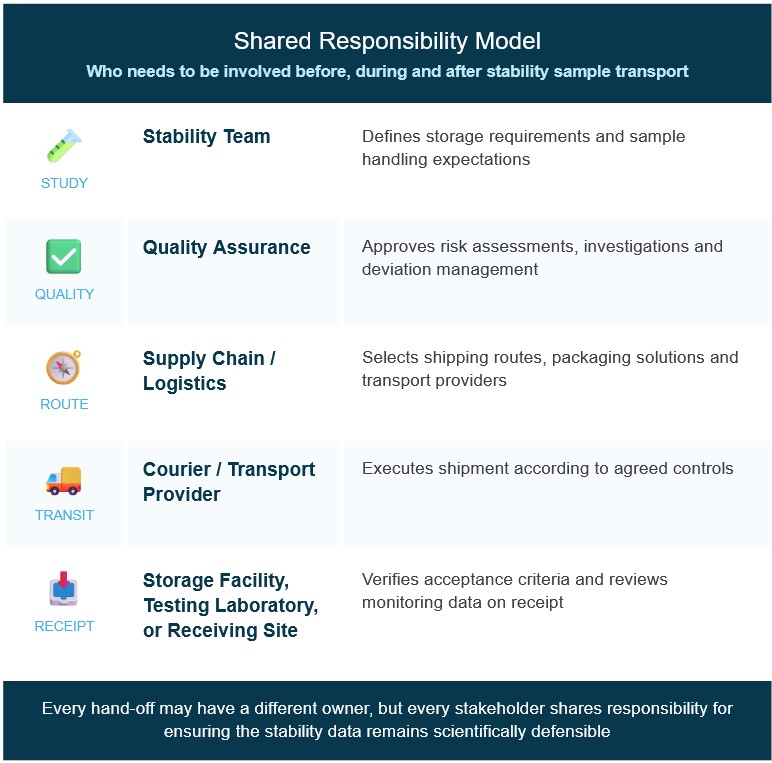
Responsibilities vary across the transport process, but responsibility for protecting data integrity is shared. Stability teams, quality, logistics, laboratories, storage facilities and transport providers each contribute evidence that supports confidence in the stability programme. A gap in monitoring, documentation, handling, communication or investigation at any stage can weaken the ability to defend the resulting stability data. For that reason, transport control is not just about ownership of a shipment; it is about collective ownership of the integrity and defensibility of the data generated from it.
The objective is not simply to move samples between locations. It is to preserve confidence in the stability data that may later be used to support storage conditions, transport strategies and the assessment of commercial excursions. Every function involved in the shipment therefore plays a role in protecting the integrity of that data.
Example Protocol: Stability Shipment Flow
A good CDMO works together with customers to define transportation requirements as part of stability storage. A typical qualification process follows a structured sequence, moving from defining the required storage conditions through to challenging the proposed transport solution under realistic operating conditions.
Where qualification identifies unacceptable risk, the route, packaging configuration, monitoring strategy or acceptance criteria may need to be revised before routine use.
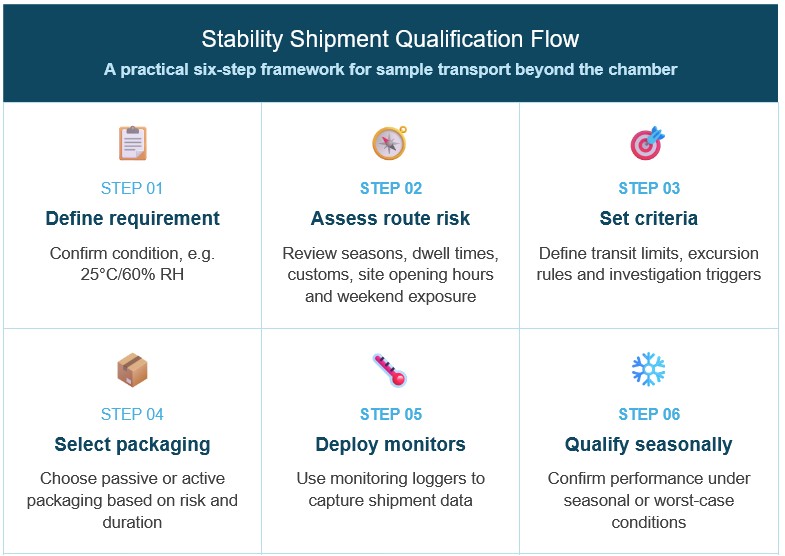
The result is not simply evidence that a shipment remained within specification. It is evidence that supports confidence in the stability data generated from those samples and the decisions that may later rely on that data.
When transport deviates from plan
When transport deviates from plan, the challenge is not simply managing the shipment. It is determining whether the resulting stability data can still be relied upon to support future product quality and transport-related decisions.
Customs delays, weather events, route changes, courier errors and equipment failures can occur even on well-qualified shipping lanes. The key question is not, “Did the shipment arrive late?” but, “Can we still rely on the data when making decisions about storage conditions, shelf life or transport excursions?”
When unexpected events occur, organizations need sufficient data, predefined criteria and clear decision-making processes to determine whether the stability data remains suitable for its intended use.
Not every deviation is equal
The significance of a transport deviation depends not only on what happened, but also on the evidence available to explain it. In many cases, the absence of reliable monitoring data can be more difficult to defend than the excursion itself, because it limits the ability to assess whether the conditions experienced during transport could affect the interpretation of the resulting stability data.
The significance of a deviation depends on:
For example, a two-hour excursion to 10°C above the target temperature may be insignificant for one product but potentially important for another. Similarly, a shipment with complete environmental monitoring data may be easier to assess than a shipment with no evidence of the conditions experienced during transit.
Consider this scenario
A stability sample is shipped from a manufacturing site to a testing laboratory. The shipment arrives on time and no issues are reported. Six months later, an unexpected trend appears in the stability data.
During the investigation, the team discovers there is no temperature record for the shipment, and no evidence of how long the samples spent outside controlled storage during transit.
The question is no longer whether the shipment arrived. The question is whether the organization can confidently determine if the stability result reflects product behavior or an undocumented transport event.
When unexpected events occur, organizations need sufficient data, predefined criteria and clear decision-making processes to determine whether the stability data remains suitable for its intended use.
1. Reviewing shipment data
Confirm what actually occurred using logger data, shipment records, tracking history, courier reports and receiving documentation.
2. Assessing potential impact
Determine whether the conditions experienced differ from those assumed during route qualification or transport validation.
3. Investigating contributing factors
Establish whether the deviation resulted from route changes, delays, packaging performance issues, handling practices or other factors.
4. Documenting scientific justification
Record the rationale supporting any decisions regarding sample suitability and continued use within the stability programme.
5. Identifying corrective actions
Where appropriate, update packaging configurations, risk assessments or transport procedures to reduce future risk.
Transport data provides information to support risk-based decision-making when unexpected events occur and helps to preserve confidence in the stability data that may later be used to support storage, distribution and transport-related decisions. Without monitoring data, organizations may have to rely on assumptions. With it, decisions can be based on documented evidence.
Final thought
Stability data is only as defensible as the evidence supporting it. If questions arose tomorrow about the transport history behind your last stability shipment, could you confidently demonstrate that the data remained reliable?
Stability studies support shelf-life claims, regulatory filings and patient safety, yet sample movement between controlled environments can remain one of the least understood parts of many programmes.
The strongest organizations treat transport as part of the stability process, not a logistics afterthought. When shipping, packaging, calibrated monitoring and risk-based planning work together, stability samples can provide reliable data and support decisions.
Because in stability science, the real question isn’t whether the shipment arrived. It’s whether the data arrived with it.
Share This Article with the Stability Community!
October 9, 2026

The Japanese authority PMDA (Pharmaceutical and Medical Device Agency) which instituted a Warning Letter system in September 2025 has issued its first Warning Letter [...]
June 28, 2026

Foreword by John O’Neill: An accelerated stability failure is not always the end of a product's story but how a failure episode concludes can [...]
February 28, 2026

Ben Was Right QC and analytical labs are facing heightened expectations as method lifecycle principles, data integrity, and digital lab tools reshape the regulatory [...]
Share your questions and experiences
A stabilitarian encounters new situations every day. StabilityHub’s discussion forums give Stabilitarians an opportunity to ask questions and offer solutions to specific scenarios. Join in the conversations with other Stabilitiarians and share your knowledge!
A stabilitarian encounters new situations every day. StabilityHub’s discussion forums give Stabilitarians an opportunity to ask questions and offer solutions to specific scenarios. Join in the conversations with other Stabilitiarians and share your knowledge!
